Female infertility
See also: Female infertility § Tobacco smoking
Smoking is harmful to the ovaries, potentially causing female infertility, and the degree of damage is dependent upon the amount and length of time a woman smokes. Nicotine and other harmful chemicals in cigarettes interfere with the body’s ability to create estrogen, a hormone that regulates folliculogenesis and ovulation. Also, cigarette smoking interferes with folliculogenesis, embryo transport, endometrial receptivity, endometrial angiogenesis, uterine blood flow and the uterine myometrium. Some damage is irreversible, but stopping smoking can prevent further damage Smokers are 60% more likely to be infertile than non-smokers. Smoking reduces the chances of IVF producing a live birth by 34% and increases the risk of an IVF pregnancy miscarrying by 30%.
Psychological
"Smokers often report that cigarettes help relieve feelings of stress. However, the stress levels of adult smokers are slightly higher than those of nonsmokers, adolescent smokers report increasing levels of stress as they develop regular patterns of smoking, and smoking cessation leads to reduced stress. Far from acting as an aid for mood control, nicotine dependency seems to exacerbate stress. This is confirmed in the daily mood patterns described by smokers, with normal moods during smoking and worsening moods between cigarettes. Thus, the apparent relaxant effect of smoking only reflects the reversal of the tension and irritability that develop during nicotine depletion. Dependent smokers need nicotine to remain feeling normal."
Immediate effects
Users report feelings of relaxation, sharpness, calmness, and alertness.Those new to smoking may experience nausea,dizziness, increased blood pressure, narrowed arteries, and rapid heart beat. Generally, the unpleasant symptoms will eventually vanish over time, with repeated use, as the body builds a tolerance to the chemicals in the cigarettes, such asnicotine.
Stress
Smokers report higher levels of everyday stress. Several studies have monitored feelings of stress over time and found reduced stress after quitting.
The deleterious mood effects of abstinence explain why smokers suffer more daily stress than non-smokers, and become less stressed when they quit smoking. Deprivation reversal also explains much of the arousal data, with deprived smokers being less vigilant and less alert than non-deprived smokers or non-smokers.
Recent studies have shown a positive relationship between psychological distress and salivary cotinine levels in smoking and non-smoking adults, indicating that both firsthand and secondhand smoke exposure may lead to higher levels of mental stress.
Social and behavioral
Medical researchers have found that smoking is a predictor of divorce. Smokers have a 53% greater chance of divorce than nonsmokers.
Cognitive function
The usage of tobacco can also create cognitive dysfunction. There seems to be an increased risk of Alzheimer's disease, although "case–control and cohort studies produce conflicting results as to the direction of the association between smoking and AD". Smoking has been found to contribute to dementia and cognitive decline, reduced memory and cognitive abilities in adolescents, and brain shrinkage (cerebral atrophy).
Most notably, some studies have found that patients with Alzheimer's disease are more likely not to have smoked than the general population, which has been interpreted to suggest that smoking offers some protection against Alzheimer's. However, the research in this area is limited and the results are conflicting; some studies show that smoking increases the risk of Alzheimer's disease. A recent review of the available scientific literature concluded that the apparent decrease in Alzheimer risk may be simply because smokers tend to die before reaching the age at which Alzheimer normally occurs. "Differential mortality is always likely to be a problem where there is a need to investigate the effects of smoking in a disorder with very low incidence rates before age 75 years, which is the case of Alzheimer's disease," it stated, noting that smokers are only half as likely as non-smokers to survive to the age of 80.
Evidence suggests that non-smokers are up to twice as likely as smokers to develop Parkinson's disease or Alzheimer's disease. A plausible explanation for these cases may be the effect of nicotine, a cholinergic stimulant, increasing the levels of acetylcholine in the smoker's brain; Parkinson's disease occurs when the effect of dopamine is less than that of acetylcholine. In addition, nicotine stimulates the mesolimbic dopamine pathway (as do other drugs of abuse), causing an effective increase in dopamine levels.
Former and current smokers have a lower incidence of Parkinson's disease compared to people who have never smoked, although the authors stated that it was more likely that the movement disorders which are part of Parkinson's disease prevented people from being able to smoke than that smoking itself was protective. Another study considered a possible role of nicotine in reducing Parkinson's risk: nicotine stimulates the dopaminergic system of the brain, which is damaged in Parkinson's disease, while other compounds in tobacco smoke inhibit MAO-B, an enzyme which produces oxidative radicals by breaking down dopamine.
In many respects, nicotine acts on the nervous system in a similar way to caffeine. Some writings have stated that smoking can also increase mental concentration; one study documents a significantly better performance on the normed Advanced Raven Progressive Matrices test after smoking.
Most smokers, when denied access to nicotine, exhibit symptoms such as irritability, jitteriness, dry mouth, and rapid heart beat.The onset of these symptoms is very fast, nicotine's half-life being only 2 hours. Withdrawal symptoms can appear even if the smoker's consumption is very limited or irregular, appearing after only 4–5 cigarettes in most adolescents.The psychological dependence may linger for months or even many years. Unlike somerecreational drugs, nicotine does not measurably alter a smoker's motor skills, judgement, or language abilities while under the influence of the drug. Tobacco withdrawal has been shown to cause clinically significant distress.
A very large percentage of schizophrenics smoke tobacco as a form of self-medication The high rate of tobacco use by the mentally ill is a major factor in their decreased life expectancy, which is about 25 years shorter than the general population. Following the observation that smoking improves condition of people with schizophrenia, in particular working memory deficit, nicotine patches had been proposed as a way to treat schizophrenia. Some studies suggest that a link exists between smoking and mental illness, citing the high incidence of smoking amongst those suffering from schizophrenia and the possibility that smoking may alleviate some of the symptoms of mental illness, but these have not been conclusive.
Recent studies have linked smoking to anxiety disorders, suggesting the correlation (and possibly mechanism) may be related to the broad class of anxiety disorders, and not limited to just depression. Current and ongoing research attempt to explore the addiction-anxiety relationship. Data from multiple studies suggest that anxiety disorders and depression play a role in cigarette smoking. A history of regular smoking was observed more frequently among individuals who had experienced a major depressive disorder at some time in their lives than among individuals who had never experienced major depression or among individuals with no psychiatric diagnosis. People with major depression are also much less likely to quit due to the increased risk of experiencing mild to severe states of depression, including a major depressive episode.Depressed smokers appear to experience more withdrawal symptoms on quitting, are less likely to be successful at quitting, and are more likely to relapse.
Pregnancy
Main article: Smoking and pregnancy
A number of studies have shown that tobacco use is a significant factor in miscarriages among pregnant smokers, and that it contributes to a number of other threats to the health of the fetus.
Environmental tobacco smoke exposure and maternal smoking during pregnancy have been shown to cause lower infant birth weights.
Studies have shown an association between prenatal exposure to environmental tobacco smoke and conduct disorder in children. As well, post-natal tobacco smoke exposure may cause similar behavioral problems in children.
Women who smoke have about a 50% higher chance of giving birth to a child with behavioral disorders, such as ADHD, but a recent study in a book called "Attention Deficit Disorder: A Different Perception" overturns this, saying that ADHD is a genetic trait. Proof of this comes from a study showing that the people with ADHD had higher levels of certain hormones, as Thom Hartman explains with the hunter vs. farmer hypothesis.
Drug interactions
Smoking is known to increase levels of liver enzymes that break down drugs and toxins. That means that drugs cleared by these enzymes are cleared more quickly in smokers, which may result in the drugs not working. Specifically, levels of CYP1A2 and CYP2A6 are induced:substrates for 1A2 include caffeine and tricyclic antidepressants such asamitriptyline; substrates for 2A6 include the anticonvulsant, valproic acid.
Other harm
See also: Women and smoking § Unique gender differences and health effects for Females
Studies suggest that smoking decreases appetite, but did not conclude that overweight people should smoke or that their health would improve by smoking. This is also a cause of heart diseases. Smoking also decreases weight by overexpressing the gene AZGP1 which stimulates lipolysis.
Smoking causes about 10% of the global burden of fire deaths, and smokers are placed at an increased risk of injury-related deaths in general, partly due to also experiencing an increased risk of dying in a motor vehicle crash.
Smoking increases the risk of symptoms associated with Crohn's disease (a dose-dependent effect with use of greater than 15 cigarettes per day). There is some evidence for decreased rates of endometriosis in infertile smoking women,although other studies have found that smoking increases the risk in infertile women. There is little or no evidence of a protective effect in fertile women. Some preliminary data from 1996 suggested a reduced incidence of uterine fibroids, but overall the evidence is unconvincing.
Current research shows that tobacco smokers who are exposed to residential radon are twice as likely to develop lung cancer as non-smokers As well, the risk of developing lung cancer from asbestos exposure is twice as likely for smokers than for non-smokers.
New research has found that women who smoke are at significantly increased risk of developing an abdominal aortic aneurysm, a condition in which a weak area of the abdominal aorta expands or bulges, and is the most common form ofaortic aneurysm.
Smoking leads to an increased risk of bone fractures, especially hip fractures. It also leads to slower wound-healing after surgery, and an increased rate of postoperative healing complication.
Benefits
In addition to the numerous documented negative health effects of smoking, several types of "Smoker’s Paradoxes" (cases where smoking appears to have specific beneficial effects) have been observed. Smoking may prevent Parkinson's disease.
Mechanism
See also: List of additives in cigarettes
Chemical carcinogens
Benzopyrene diol epoxide, an extremely carcinogenic (cancer-causing) metabolite of benzopyrene, a polycyclic aromatic hydrocarbon produceurd by bning tobacco.
Benzopyrene, a major mutagen in tobacco smoke, in an adduct to DNA.
See also: List of cigarette smoke carcinogens
Smoke, or any partially burnt organic matter, contains carcinogens (cancer-causing agents). The potential effects of smoking, such as lung cancer, can take up to 20 years to manifest themselves. Historically, women began smoking en masse later than men, so an increased death rate caused by smoking amongst women did not appear until later. The male lung cancer death rate decreased in 1975 — roughly 20 years after the initial decline in cigarette consumption in men. A fall in consumption in women also began in 1975 but by 1991 had not manifested in a decrease in lung cancer related mortalities amongst women.
Smoke contains several carcinogenic pyrolytic products that bind to DNA and causegenetic mutations. Particularly potent carcinogens are polycyclic aromatic hydrocarbons (PAH), which are toxicated to mutagenic epoxides. The first PAH to be identified as a carcinogen in tobacco smoke was benzopyrene, which has been shown to toxicate into an epoxide that irreversibly attaches to a cell's nuclear DNA, which may either kill the cell or cause a genetic mutation. If the mutation inhibits programmed cell death, the cell can survive to become a cancer cell. Similarly, acrolein, which is abundant in tobacco smoke, also irreversibly binds to DNA, causes mutations and thus also cancer. However, it needs no activation to become carcinogenic.
There are over 19 known carcinogens in cigarette smoke. The following are some of the most potent carcinogens:
- Polycyclic aromatic hydrocarbons are tar components produced by pyrolysis in smoldering organic matter and emitted into smoke. Several of these PAH's are already toxic in their normal form, however many of then can become more toxic in the liver. Due to the hydrophobic nature of PAH's they do not dissolve in water and are hard to expel from the body. In order to make the PAH more soluble in water, the liver creates an enzyme called Cytochrome P450 which adds an additionaloxygen to the PAH, turning it into a mutagenic epoxides, which is more soluble, but also more reactive. The first PAH to be identified as a carcinogen in tobacco smoke was benzopyrene, which been shown to toxicate into a diol epoxide and then permanently attach to nuclear DNA, which may either kill the cell or cause a genetic mutation. The DNA contains the information on how the cell function; in practice, it contains the recipes for protein synthesis. If the mutation inhibits programmed cell death, the cell can survive to become a cancer cell, a cell that does not function like a normal cell. The carcinogenity is radiomimetic, i.e. similar to that produced by ionizing nuclear radiation. Tobacco manufacturers have experimented with combustionless vaporizer technology to allow cigarettes to be consumed without the formation of carcinogenic benzopyrenes. Although such products have become increasingly popular, they still represent a very small fraction of the market, and no conclusive evidence has shown to prove or disprove the positive health claims.
- Acrolein is a pyrolysis product that is abundant in cigarette smoke. It gives smoke an acrid smell and an irritating, lachromatory effect and is a major contributor to its carcinogenity. Like PAH metabolites, acrolein is also an electrophilic alkylating agent and permanently binds to the DNA base guanine, by a conjugate addition followed by cyclization into ahemiaminal. The acrolein-guanine adduct induces mutations during DNA copying and thus causes cancers in a manner similar to PAHs. However, acrolein is 1000 times more abundant than PAHs in cigarette smoke, and is able to react as is, without metabolic activation. Acrolein has been shown to be a mutagen and carcinogen in human cells. The carcinogenity of acrolein has been difficult to study by animal experimentation, because it has such a toxicity that it tends to kill the animals before they develop cancer. Generally, compounds able to react by conjugate addition aselectrophiles (so-called Michael acceptors after Michael reaction) are toxic and carcinogenic, because they can permanently alkylate DNA, similarly to mustard gas or aflatoxin. Acrolein is only one of them present in cigarette smoke; for example, crotonaldehyde has been found in cigarette smoke. Michael acceptors also contribute to the chronic inflammation present in tobacco disease.
- Nitrosamines are a group of carcinogenic compounds found in cigarette smoke but not in uncured tobacco leaves. Nitrosamines form on flue-cured tobacco leaves during the curing process through a chemical reaction between nicotine and other compounds contained in the uncured leaf and various oxides of nitrogen found in all combustion gases. Switching to Indirect fire curing has been shown to reduce nitrosamine levels to less than 0.1 parts per million.
Sidestream tobacco smoke, or exhaled mainstream smoke, is particularly harmful. Because exhaled smoke exists at lower temperatures than inhaled smoke, chemical compounds undergo changes which can cause them to become more dangerous. As well, smoke undergoes changes as it ages, which causes the transformation of the compound NO into the more toxic NO2. Further, volatilization causes smoke particles to become smaller, and thus more easily embedded deep into the lung of anyone who later breathes the air.
Radioactive carcinogens
In addition to chemical, nonradioactive carcinogens, tobacco and tobacco smoke contain small amounts of lead-210 and polonium-210 both of which are radioactive carcinogens. The presence of polonium-210 in mainstream cigarette smoke has been experimentally measured at levels of 0.0263–0.036 pCi (0.97–1.33 mBq), which is equivalent to about 0.1 pCi per milligram of smoke (4 mBq/mg); or about 0.81 pCi of lead-210 per gram of dry condensed smoke (30 Bq/kg).
Research by NCAR radiochemist Ed Martell suggested that radioactive compounds in cigarette smoke are deposited in "hot spots" where bronchial tubes branch, that tar from cigarette smoke is resistant to dissolving in lung fluid and that radioactive compounds have a great deal of time to undergo radioactive decay before being cleared by natural processes. Indoors, these radioactive compounds can linger in secondhand smoke, and greater exposure would occur when these radioactive compounds are inhaled during normal breathing, which is deeper and longer than when inhaling cigarettes. Damage to the protective epithelial tissue from smoking only increases the prolonged retention of insoluble polonium-210 compounds produced from burning tobacco. Martell estimated that a carcinogenic radiation dose of 80–100 rads is delivered to the lung tissue of most smokers who die of lung cancer.
Smoking an average of 1.5 packs per day gives a radiation dose of 60-160 mSv/year, compared with living near a nuclear power station (0.0001 mSv/year) or the 3.0 mSv/year average dose for Americans. Some of the mineral apatite in Florida used to produce phosphate for U.S.A. tobacco crops contains uranium, radium, lead-210 and polonium-210 and radon. The radioactive smoke from tobacco fertilized this way is deposited in lungs and releases radiation even if a smoker quits the habit. The combination of carcinogenic tar and radiation in a sensitive organ such as lungs increases the risk of cancer.
In contrast, a 1999 review of tobacco smoke carcinogens published in the Journal of the National Cancer Institute states that "levels of polonium-210 in tobacco smoke are not believed to be great enough to significantly impact lung cancer in smokers." The same author has also stated that the "levels of 201Po in cigarette smoke are probably too low to be involved in lung cancer induction ..."
Nicotine
Nicotine, which is contained in cigarettes and other smoked tobacco products, is astimulant and is one of the main factors leading to continued tobacco smoking.Nicotine is a highly addictive psychoactive chemical. When tobacco is smoked, most of the nicotine is pyrolyzed; a dose sufficient to cause mild somatic dependency and mild to strong psychological dependency remains. The amount of nicotine absorbed by the body from smoking depends on many factors, including the type of tobacco, whether the smoke is inhaled, and whether a filter is used. There is also a formation of harmane (a MAO inhibitor) from the acetaldehyde in cigarette smoke, which seems to play an important role in nicotine addictionprobably by facilitating dopamine release in the nucleus accumbens in response to nicotine stimuli. According to studies by Henningfield and Benowitz, nicotine is more addictive thancannabis, caffeine, ethanol, cocaine, and heroin when considering both somatic and psychological dependence. However, due to the stronger withdrawal effects of ethanol, cocaine and heroin, nicotine may have a lower potential for somatic dependence than these substances. About half of Canadians who currently smoke have tried to quit. McGill University health professor Jennifer O'Loughlin stated that nicotine addiction can occur as soon as five months after the start of smoking.
Ingesting a compound by smoking is one of the most rapid and efficient methods of introducing it into the bloodstream, second only to injection, which allows for the rapid feedback which supports the smokers' ability to titrate their dosage. On average it takes about ten seconds for the substance to reach the brain. As a result of the efficiency of this delivery system, many smokers feel as though they are unable to cease. Of those who attempt cessation and last three months without succumbing to nicotine, most are able to remain smoke-free for the rest of their lives. There exists a possibility of depression in some who attempt cessation, as with other psychoactive substances. Depression is also common in teenage smokers; teens who smoke are four times as likely to develop depressive symptoms as their nonsmoking peers.
Although nicotine does play a role in acute episodes of some diseases (including stroke, impotence, and heart disease) by its stimulation of adrenaline release, which raises blood pressure, heart and respiration rate, and free fatty acids, the most serious longer term effects are more the result of the products of the smouldering combustion process. This has led to the development of various nicotine delivery systems, such as the nicotine patch or nicotine gum, that can satisfy the addictive craving by delivering nicotine without the harmful combustion by-products. This can help the heavily dependent smoker to quit gradually, while discontinuing further damage to health.
Recent evidence has shown that smoking tobacco increases the release of dopamine in the brain, specifically in the mesolimbic pathway, the same neuro-reward circuit activated by drugs of abuse such as heroin and cocaine. This suggests nicotine use has a pleasurable effect that triggers positive reinforcement. One study found that smokers exhibit better reaction-time and memory performance compared to non-smokers, which is consistent with increased activation of dopamine receptors. Neurologically, rodent studies have found that nicotine self-administration causes lowering of reward thresholds—a finding opposite that of most other drugs of abuse (e.g. cocaine and heroin). This increase in reward circuit sensitivity persisted months after the self-administration ended, suggesting that nicotine's alteration of brain reward function is either long lasting or permanent. Furthermore, it has been found that nicotine can activate long term potentiation in vivo and in vitro. These studies suggest nicotine’s "trace memory" may contribute to difficulties in nicotine abstinence.
The carcinogenity of tobacco smoke is not explained by nicotine per se, which is not carcinogenic or mutagenic, although it is a metabolic precursor for several compounds which are In addition, it inhibits apoptosis, therefore accelerating existing cancers. Also, NNK, a nicotine derivative converted from nicotine, can be carcinogenic.
It is worth noting that nicotine, although frequently implicated in producing tobacco addiction, is not significantly addictive when administered alone. The addictive potential manifests itself after co-administration of an MAOI, which specifically causes sensitization of the locomotor response in rats, a measure of addictive potential.
Particular forms of exposure
Second-hand smoke
Main article: Passive smoking
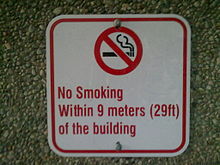
Posted sign to avoid passive smoking in York University, Toronto,Ontario, Canada.
Second-hand smoke is a mixture of smoke from the burning end of a cigarette, pipe or cigar and the smoke exhaled from the lungs of smokers. It is involuntarily inhaled, lingers in the air hours after cigarettes have been extinguished, and may cause a wide range of adverse health effects, including cancer, respiratory infections andasthma. Non-smokers who are exposed to second-hand smoke at home or work are thought, due to a wide variety of statistical studies, to increase their heart disease risk by 25–30% and their lung cancer risk by 20–30%. Second-hand smoke has been estimated to cause 38,000 deaths per year, of which 3,400 are deaths from lung cancer in non-smokers.
The current US Surgeon General’s Report concludes that there is no established risk-free level of exposure to second-hand smoke. Short exposures to second-hand smoke are believed to cause blood platelets to become stickier, damage the lining of blood vessels, decrease coronary flow velocity reserves, and reduce heart rate variability, potentially increasing the risk of heart attack. New research indicates that private research conducted by cigarette company Philip Morris in the 1980s showed that second-hand smoke was toxic, yet the company suppressed the finding during the next two decades.
Chewing tobacco
Chewing tobacco has been known to cause cancer, particularly of the mouth and throat.According to the International Agency for Research on Cancer, "Some health scientists have suggested that smokeless tobacco should be used in smoking cessation programmes and have made implicit or explicit claims that its use would partly reduce the exposure of smokers to carcinogens and the risk for cancer. These claims, however, are not supported by the available evidence."Oral and spit tobacco increase the risk for leukoplakia a precursor to oral cancer.
Cigars
Like other forms of smoking, cigar smoking poses a significant health risk depending on dosage: risks are greater for those who inhale more when they smoke, smoke more cigars, or smoke them longer.The risk of dying from any cause is significantly greater for cigar smokers, with the risk particularly higher for smokers less than 65 years old, and with risk for moderate and deep inhalers reaching levels similar to cigarette smokers. The increased risk for those smoking 1–2 cigars per day is too small to be statistically significant, and the health risks of the 3/4 of cigar smokers who smoke less than daily are not known and are hard to measure. Although it has been claimed that people who smoke few cigars have no increased risk, a more accurate statement is that their risks are proportionate to their exposure. Health risks are similar to cigarette smoking in nicotine addiction, periodontal health, tooth loss, and many types of cancer, including cancers of the mouth, throat, and esophagus. Cigar smoking also can cause cancers of the lung and larynx, where the increased risk is less than that of cigarettes. Many of these cancers have extremely low cure rates. Cigar smoking also increases the risk of lung and heart diseases such as chronic obstructive pulmonary disease.
Hookahs
A common belief among users is that the smoke of a hookah (waterpipe, narghile) is significantly less dangerous than that from cigarettes. The water moisture induced by the hookah makes the smoke less irritating and may give a false sense of security and reduce concerns about true health effects. Doctors at institutions including the Mayo Clinic have stated that use of hookah can be as detrimental to a person's health as smoking cigarettes, and a study by the World Health Organization also confirmed these findings.
Each hookah session typically lasts more than 40 minutes, and consists of 50 to 200 inhalations that each range from 0.15 to 0.50 liters of smoke.In an hour-long smoking session of hookah, users consume about 100 to 200 times the smoke of a single cigarette; in a 45-minute smoking session a typical smoker would inhale 1.7 times the nicotine of a single cigarette. A study in the Journal of Periodontology found that water pipe smokers were five times more likely than non-smokers to show signs of gum disease. According to USA Today, people who smoked water pipes had five times the risk of lung cancer of non-smokers.
A study on hookah smoking and cancer in Pakistan was published in 2008. Its objective was "to find serum CEA levels in ever/exclusive hookah smokers, i.e. those who smoked only hookah (no cigarettes, bidis, etc.), prepared between 1 and 4 times a day with a quantity of up to 120 g of a tobacco-molasses mixture each (i.e. the tobacco weight equivalent of up to 60 cigarettes of 1 g each) and consumed in 1 to 8 sessions". Carcinoembryonic antigen (CEA) is a marker found in several forms of cancer. Levels in exclusive hookah smokers were lower compared to cigarette smokers although the difference was not as statistically significant as that between a hookah smoker and a non-smoker. Also the study concluded that heavy hookah smoking (2–4 daily preparations; 3–8 sessions a day ; >2 hrs to ≤ 6 hours) substantially raises CEA levels. Hookah smokers were nearly 6 times more likely to develop lung cancer as compared to healthy non-smokers in Kashmir (India).
Snuff
Snuff is also put in the mouth, but it is a flavored powder. it is placed between the cheek and gum. Snuff doesn't need to be chewed for the nicotine to be absorbed into your body. First time users of these products often become nauseated and dizzy. Long-term effects include bad breath, yellowed teeth, and an increased risk of oral cancer.
Users of snuff are believed to face less risk of some cancers than smokers, but are still at greater risk than people who do not use any tobacco products. They also have an equal risk of other health problems directly linked to nicotine such as increased rate of atherosclerosis.
Prevention
Education and counselling by physicians of children and adolescents has been found to be effective in decreasing the risk of tobacco use.
Usage
Percentage of females smoking any tobacco product
Percentage of males smoking any tobacco product. Note that there is a difference between the scales used for females and the scales used for males.
Though tobacco may be consumed by either smoking or other smokeless methods such as chewing, the World Health Organization (WHO) only collects data on smoked tobacco. Smoking has therefore been studied more extensively than any other form of tobacco consumption.
In 2000, smoking was practiced by 1.22 billion people, predicted to rise to 1.45 billion people in 2010 and 1.5 to 1.9 billion by 2025. If prevalence had decreased by 2% a year since 2000 this figure would have been 1.3 billion in 2010 and 2025. Despite dropping by 0.4 percent from 2009 to 2010, the United States still reports an average of 17.9 percent usage.
As of 2002, about twenty percent of young teens (13–15) smoke worldwide, with 80,000 to 100,000 children taking up the addiction every day—roughly half of whom live in Asia. Half of those who begin smoking in adolescent years are projected to go on to smoke for 15 to 20 years.
The WHO states that "Much of the disease burden and premature mortality attributable to tobacco use disproportionately affect the poor". Of the 1.22 billion smokers, 1 billion of them live in developing or transitional nations. Rates of smoking have leveled off or declined in the developed world. In thedeveloping world, however, tobacco consumption is rising by 3.4% per year as of 2002.
The WHO in 2004 projected 58.8 million deaths to occur globally, from which 5.4 million are tobacco-attributed,23and 4.9 million as of 2007. As of 2002, 70% of the deaths are in developing countries.
The shift in prevalence of tobacco smoking to a younger demographic, mainly in the developing world, can be attributed to several factors. The tobacco industry spends up to $12.5 billion annually on advertising, which is increasingly geared towards adolescents in the developing world because they are a very vulnerable audience for the marketing campaigns. Adolescents have more difficulty understanding the long term health risks that are associated with smoking and are also more easily influenced by "images of romance, success, sophistication, popularity, and adventure which advertising suggests they could achieve through the consumption of cigarettes". This shift in marketing towards adolescents and even children in the tobacco industry is debilitating to organizations’ and countries’ efforts to improve child health and mortality in the developing world. It reverses or halts the effects of the work that has been done to improve health care in these countries, and although smoking is deemed as a "voluntary" health risk, the marketing of tobacco towards very impressionable adolescents in the developing world makes it less of a voluntary action and more of an inevitable shift.
Many government regulations have been passed to protect citizens from harm caused by public environmental tobacco smoke. The "Pro-Children Act of 2001" prohibits smoking within any facility that provides health care, day care, library services, or elementary and secondary education to children in the USA. On May 23, 2011, New York City enforced a smoking ban for all parks, beaches, and pedestrian malls in an attempt to eliminate threats posed to civilians by environmental tobacco smoke.
History
Concern about health effects of tobacco has a long history. Gideon Lincecum, an American naturalist and practitioner of botanical medicine, wrote in the early 19th century on tobacco: "This poisonous plant has been used a great deal as a medicine by the old school faculty, and thousands have been slain by it. ... It is a very dangerous article, and use it as you will, it always diminishes the vital energies in exact proportion to the quantity used - it may be slowly, but it is very sure."
The late-19th century invention of automated cigarette-making machinery in the American South made possible mass production of cigarettes at low cost, and cigarettes became elegant and fashionable among society men as the Victorian era gave way to the Edwardian. In 1912, American Dr. Isaac Adler was the first to strongly suggest that lung cancer is related to smoking. In 1924, economist Irving Fisher wrote an anti-smoking article for the Readers Digest, which said "... tobacco lowers the whole tone of the body and decreases its vital power and resistance ... tobacco acts like a narcotic poison, like opium and like alcohol, though usually in a less degree". In 1929, Fritz Lickint of Dresden, Germany, published a formal statistical evidence of a lung cancer-tobacco link, based on a study showing that lung cancer sufferers were likely to be smokers. Lickint also argued that tobacco use was the best way to explain the fact that lung cancer struck men four or five times more often than women (since women smoked much less).
Prior to World War I, lung cancer was considered to be a rare disease, which most physicians would never see during their career. With the postwar rise in popularity of cigarette smoking, however, came an epidemic of lung cancer.
In 1950, Richard Doll published research in the British Medical Journal showing a close link between smoking and lung cancer. Four years later, in 1954, the British Doctors Study, a study of some 40,000 doctors over 20 years, confirmed the suggestion, based on which the government issued advice that smoking and lung cancer rates were related.The British Doctors Study lasted until 2001, with results published every ten years and final results published in 2004 by Doll andRichard Peto. Much early research was also done by Alton Ochsner. Reader's Digest magazine for many years published frequent anti-smoking articles. On January 11, 1964, the United States Surgeon General's Report on Smoking and Health was published; this led millions of American smokers to quit, the banning of certain advertising, and the requirement of warning labels on tobacco products.
Studies
In the 1930s German scientists showed that cigarette smoking caused lung cancer. In 1938 a study by a Johns Hopkins University scientist suggested a strongly negative correlation between smoking and lifespan. In 1950 five studies were published in which "smoking was powerfully implicated in the causation of lung cancer". These included the now classic paper "Smoking and Carcinoma of the Lung" which appeared in the British Medical Journal. This paper reported that "heavy smokers were fifty times as likely as non-smokers to contract lung cancer".
In 1953, scientists at the Sloan-Kettering Institute in New York City demonstrated that cigarette tar painted on the skin of mice caused fatal cancers. This work attracted much media attention; the New York Times and Life both covered the issue. The Reader's Digest published an article entitled "Cancer by the Carton".
A team of British scientists headed by Richard Doll carried out a longitudinal study of 34,439 medical specialists from 1951 to 2001, generally called the "British Doctors Study. The study demonstrated that about half of the persistent cigarette smokers born in 1900–1909 were eventually killed by their addiction (calculated from the logarithms of the probabilities of surviving from 35–70, 70–80, and 80–90) and about two thirds of the persistent cigarette smokers born in the 1920s would eventually be killed by their addiction.
The health effects of smoking have been significant for the development of the science of epidemiology. As the mechanism of carcinogenicity is radiomimetic or radiological, the effects are stochastic. Definite statements can be made only on the relative increased or decreased probabilities of contracting a given disease. For a particular individual, it is impossible to definitively prove a direct causal link between exposure to a radiomimetic poison such as tobacco smoke and the cancer that follows; such statements can only be made at the aggregate population level. Tobacco companies have capitalized on this philosophical objection and exploited the doubts of clinicians, who consider only individual cases, on the causal link in the stochastic expression of the toxicity as actual disease.
There have been multiple court cases on the issue that tobacco companies have researched the health effects of tobacco, but suppressed the findings or formatted them to imply lessened or no hazard.
The term "smoker" is given to a person who habitually smokes tobacco on a daily basis. This category has been the focus of the vast majority of tobacco studies. However, the health effects of less-than-daily smoking are far less well understood. Studies have often taken the data of "occasional smokers" (those who have never smoked daily) and grouped them with those who have never smoked. A 2006 European study on occasional smoking published findings that the risk of the major smoking-related cancers for occasional smokers was 1.24 times that of those who have never smoked at all but the result was not statistically significant. (For a confidence interval of 95%, this data showed an incidence rate ratio of 0.80 to 1.94.) (Data reduction used Cox proportional hazard model, stratified by gender and country.) This compares to studies showing that habitual heavy smokers have greater than 50 times the incidence of smoking-related cancers.
After a ban on smoking in all enclosed public places was introduced in Scotland in March 2006, there was a 17 percent reduction in hospital admissions for acute coronary syndrome. 67% of the decrease occurred in non-smokers.
A study published in the journal Pediatrics refers to the danger posed by what the authors call "third-hand smoke" — toxic substances that remain in areas where smoking has recently occurred.